Monet painting, by Auguste Renoir
Monet was born in Paris on 14 November 1840 and died at his home in Giverny, outside Paris, on 5 December 1926. In 1874 his painting Impression Sunrise, gave the name to the art movement Impressionism.
Monet studied art in Paris, first at the Academie Suisse (in 1859), then after two years of military service in Algeria at the atelier of Charles Gleyre, where he met artists who would become fellow Impressionists: Renoir, Sisley, and Bazille.
Monet exhibited at the official Paris Salon for the first time in 1865 (two seascapes of the Seine estuary), and several times thereafter. In 1874 Monet exhibited in a group show of artists who'd been rejected by the salon. The art critic Louis Leroy titled his review of the show The Exhibition of the Impressionists, after Monet's painting called Impression: Sunrise (now in the collection of the Musée Marmottan in Paris).
Monet was primarily a painter of landscapes, fascinated by the effect of light and the way it changed during the day. He used a painting technique known as broken color, and with visible brushmarks (rather than eliminating them). He worked both plein air and in his studio. In the 1890s Monet started working on series paintings, painting the same subject at different times and seasons. Subjects for his series paintings included haystacks, Rouen Cathedral, and the lily pond he created in his garden at Giverny.
Monet married twice, and that is a story in itself which I may blog about later. Meanwhile, I wanted to honor him in his birthday week. He is a pioneer in the world of art and was persistent in his pursuit of capturing his impression of landscapes.
Monet's palette. I was fortunate to visit Giverny and saw his glorious studio, every artist's dream.
Thursday, November 15, 2012
Wednesday, November 14, 2012
How Birds Get Their Eye Color
Eye colors of birds surpass what is possible for humans, and James Currie takes us on another color adventure below.
As humans we place exceptional value in the beauty of an individual’s eyes. Most of us will have heard the saying, “Eyes are the windows to the soul”. But besides the cosmetic value, the color of our eyes provides little other benefit to our lives. I have been wondering if it is the same with birds.
Eye color is even more varied in birds than it is in humans. For example, you don’t hear of people with red eyes. Eye color in birds can vary from black to brown to red to orange to yellow to blue to green to white and many colors in between. The color of a bird’s eye, as in the color of a bird’s feather, can be caused by both pigments and refraction of light. In fact, many birds exhibit more pigment coloration in their eyes than humans (for the scientifically-minded these pigments are called pteridines, purines and carotenoids).
The actual benefits of eye color in birds, as in humans, appears to be mostly limited to the cosmetic, although its quite possible that certain eye colors are more sensitive to certain light conditions. In humans, many babies are born with blue eyes, only for their eye color to gradually change from blue to green or from blue to green and then to brown. Likewise in birds, eye color can be an indication of age. And this is often a great tool for identifying a young bird in the field. But a fundamental difference between eye color in birds and humans is that for quite a number of birds, eye color actually changes according to the breeding season. For example, the iris of the Brown Pelican becomes a stunning blue color during the breeding season. Its probably a good thing that this doesn’t happen in humans.
Changes in eye color that are dictated by age and by breeding season are likely to be under some form of hormonal control. Age-dictated color changes are found in a wide variety of birds including raptors, woodpeckers, grebes, thrushes, ducks, gulls, loons and vireos. In many birds that require long periods between juvenile and adult plumage there is a gradient of color change. For example, a first cycle Western Gull has dark brown, almost black, eyes. Some Western Gulls begin to show paler, lighter brown eyes in their second cycle. In their third cycle many individuals begin to display olive-green eyes. And by their fourth and adult cycles, most Western Gulls display the pale greenish-white eyes that they are known for (refer to Steve Howell and Jon Dunn’s book Gulls of the Americas for great info on gull ID).
This juvenile White Ibis will need to wait a while until it gets the beautiful blue eyes of the adult below
Another example of a dramatic age-related color gradient change can be found in the bright yellow to red eye color changes in Sharp-shinned Hawks. Exactly what purposes these color changes serve is uncertain and it could be that, as in human babies, there is no benefit or purpose for these changes whatsoever. But, could it be that these eye color changes help certain bird species to establish the maturity of potential mates? Now there’s a thesis topic for a Cornell graduate student if it hasn’t been done already!
The most obvious difference between eye color in birds and humans is the fact that in certain species of birds, males and females have radically different eye colors. For example male Saddle-billed Storks have dark brown, almost black eyes, and females have bright yellow eyes.
As humans we place exceptional value in the beauty of an individual’s eyes. Most of us will have heard the saying, “Eyes are the windows to the soul”. But besides the cosmetic value, the color of our eyes provides little other benefit to our lives. I have been wondering if it is the same with birds.
Eye color is even more varied in birds than it is in humans. For example, you don’t hear of people with red eyes. Eye color in birds can vary from black to brown to red to orange to yellow to blue to green to white and many colors in between. The color of a bird’s eye, as in the color of a bird’s feather, can be caused by both pigments and refraction of light. In fact, many birds exhibit more pigment coloration in their eyes than humans (for the scientifically-minded these pigments are called pteridines, purines and carotenoids).
The actual benefits of eye color in birds, as in humans, appears to be mostly limited to the cosmetic, although its quite possible that certain eye colors are more sensitive to certain light conditions. In humans, many babies are born with blue eyes, only for their eye color to gradually change from blue to green or from blue to green and then to brown. Likewise in birds, eye color can be an indication of age. And this is often a great tool for identifying a young bird in the field. But a fundamental difference between eye color in birds and humans is that for quite a number of birds, eye color actually changes according to the breeding season. For example, the iris of the Brown Pelican becomes a stunning blue color during the breeding season. Its probably a good thing that this doesn’t happen in humans.
Changes in eye color that are dictated by age and by breeding season are likely to be under some form of hormonal control. Age-dictated color changes are found in a wide variety of birds including raptors, woodpeckers, grebes, thrushes, ducks, gulls, loons and vireos. In many birds that require long periods between juvenile and adult plumage there is a gradient of color change. For example, a first cycle Western Gull has dark brown, almost black, eyes. Some Western Gulls begin to show paler, lighter brown eyes in their second cycle. In their third cycle many individuals begin to display olive-green eyes. And by their fourth and adult cycles, most Western Gulls display the pale greenish-white eyes that they are known for (refer to Steve Howell and Jon Dunn’s book Gulls of the Americas for great info on gull ID).
The most obvious difference between eye color in birds and humans is the fact that in certain species of birds, males and females have radically different eye colors. For example male Saddle-billed Storks have dark brown, almost black eyes, and females have bright yellow eyes.
A male Saddle-billed Stork has dark brown eyes
Similar examples exist amongst North American birds. Female Boat-tailed Grackles and Brewer’s Blackbirds have dark eyes whereas the males have bright pale yellowish/greenish-white eyes.
A brightly colored iris in a bird could signify various things. It could function as a “badge”, distinguishing between different age classes. It could advertise sex during the breeding season. It could even help to differentiate between the sexes year-round. The possibility exists that iris color is helpful to birds that live predominantly in certain light conditions. Or it could simply be that the coloration is caused by the chemical make-up of the eye, with little to know function at all. Whatever the reasons for eye color in birds, it makes for a fascinating macro-study of our favorite avian subjects.
I hope James continues to research and photograph birds plus share his fascinating information with those of us who will probably not experience seeing these colorful creatures ourselves.
Wednesday, November 7, 2012
How Do Birds Get Their Color?
Some of the brightest colored animals on our planet are birds. The photographs and comments following will reveal how birds get their colors. The guest author is James Currie.

About the Author
A life-long birder and native of South Africa, James Currie has many years experience in the birding and wildlife tourism arenas. James has led professional wildlife and birding tours for 15 years and his passion for birding and remote cultures has taken him to far corners of the earth from the Amazon and Australia to Africa and Madagascar. He is also an expert in the field of sustainable development and holds a Bachelor’s Degree in African Languages and a Masters degree in Sustainable Environmental Management. From 2004-2007 James worked as the Managing Director of Africa Foundation, a non-profit organization that directs its efforts towards the uplifting of communities surrounding wildlife areas in Africa. James is currently the host and owner of Nikon's Birding Adventures TV and he resides in West Palm Beach, Florida.
How do Birds get their Color?
Birds have captivated us for time eternal, not only because of their ability to fly, but also because of the color they add to our lives. Okay, let me be clear that I’m not suggesting that ALL birds are colorful. Birds like Plain Chachalacas and Grey Catbirds hardly evoke images of stunning beauty. But a vast number of species DO exhibit dazzling displays of color. And these displays are not always what they might seem.
The red in this Scarlet Tanager is produced by carotenoid pigments – and the black color, by melanin
The blue vents and green backs of these White-fronted Bee-eaters are caused by blue and green scattering
And like any really good dish, there are times when several ingredients need to be mixed together to produce a really good recipe. And both keratin and pigments can be combined to produce certain colors. The greens of many parrot species are caused by blue scattered light (produced by keratin) interacting with yellow carotenoids (produced by pigments in the feathers). Grey feathers are produced by the combination of scattered white light and melanin pigments.
Learning a little about how color is produced in birds now presents me with an entirely new birding challenge when out in the field: figuring out the various color recipes that birds employ to dazzle!
James' next post will cover how birds get their eye color.
Have you ever wondered why grackles look iridescent blue in good light and black in bad light? Or why the colorful gorgets of male hummingbirds appear and then disappear without warning? This is because color in birds is not a simple thing. But rather it is a complex concoction of some very specific recipes. There are two main ingredients that are essential in the making of color. The first is pigment and the second is keratin. And the ways in which these two fundamental ingredients are added to the color cooking pot are what produces the final colors that we see.
Pigments are relatively simple color makers. There are three main pigments that give feathers their colors. The first pigment is called melanin and it produces black or dark brown coloration. Melanin is also very strong and is thus often reserved for the flight feathers. White feathers are caused by a lack of pigmentation and are much weaker than black feathers due to the lack of melanin. This might explain why many predominantly-white bird species have entirely black or black-tipped feathers in their wings. These feathers are exposed to the greatest wear and are required to be stronger than regular feathers.
The second group of pigments are called carotenoids and they produce red, orange or yellow feathers. Carotenoids are produced by plants. When birds ingest either plant matter or something that has eaten a plant, they also ingest the carotenoids that produce the colors in their feathers. The pink color of flamingoes, for example, is derived from carotenoids found in the crustaceans and algae that the birds sieve from the water.
The third group of pigments are called porphyrins and these are essentially modified amino acids. Porphyrins can produce red, brown, pink and green colors. This pigment group is the rarest of the three pigment groups and is found in only a handful of bird families. The best-known example of porphyrins is the red pigment (often called turacin) that is found in many turaco species and turacoverdin, the green pigment found in many of the same turaco species.
Mixtures of pigments can also produce different and unusual color hues and shades. For example, the dull olive-green colors of certain forest birds is actually a mixture of yellow carotenoid pigments and dark-brown melanin pigments.
Then we get to the second main ingredient that produces color: keratin. Keratin is the tough protein of which feathers are made. It also covers birds’ bills, feet and legs. Keratin is responsible for the iridescent coloring of many spectacular bird species. How keratin produces color is a rather complex process but, from what I’ve read on the subject, I shall attempt to simplify it as follows. Keratin produces color in two main ways: by layering and by scattering.
Layering colors are produced when translucent keratin reflects short wave-lengths of colors like blues, violets, purples and greens. The other colors are absorbed by an underlying melanin (black) layer. The ways in which the keratin of the feathers are layered will dictate the color of the iridescence. Examples of layered coloring include the iridescence of glossy starlings and the speculums or wing patches of many duck species.
Scattering is produced when the keratin of feathers is interspersed with tiny air pockets within the structure of the feathers themselves. These air pockets and the interspersed keratin scatter blue and green light and produce the shimmering colors of birds like kingfishers, rollers and bee-eaters. The magnificence of some of these scattered colors is wonderfully exhibited in Adam Riley’s post on the “Bee-eaters of Africa”.
Learning a little about how color is produced in birds now presents me with an entirely new birding challenge when out in the field: figuring out the various color recipes that birds employ to dazzle!
James' next post will cover how birds get their eye color.
Tuesday, November 6, 2012
Color Terms
15 Color Terms
by Mark Nichol
1. Cast: a change in appearance or color by adding one color over another; also, multiple senses of assigning, depositing, directing, shaping, spreading, turning, or twisting
2. Chroma: a combination of hue and saturation (see definitions below), or synonymous with saturation
3. Chromaticity: the quality of color based on wavelength and purity
4. Coloration: the condition of coloring, as in skin tone, an arrangement of colors, or the choice or use of colors
5. Colorway: a color or arrangement of colors
6. Contrast: the degree of difference in colors or light and dark, or their juxtaposition
7. Hue: color, gradation of color, or the characteristic that distinguishes one color from another
8. Pigmentation: coloration caused by the presence of a pigment, a substance that produces a color (or black and white) in a material
9. Saturation: purity of color; also, the state of being thoroughly wet, or heavy infiltration
10. Shade: a color produced by a mixture that includes black dye or pigment, or a color somewhat distinct from another, or, as a verb, to produce such a color; also, various meanings associated with the blocking or minimizing of light
11. Tincture: synonymous with color; also, a trace in a mixture
12. Tinge: color spread or stained over another color, or, as a verb, to spread or stain one color over another; also, a figurative sense of a light touch or effect, or, as a verb, to touch or effect lightly
13. Tint: a pale or slight coloration, or lighter or darker variations of a color, or, as a verb, to produce such an effect; also, a slight difference, or hair dye
14. Tone: a quality of color, or a shade, tint, or value (see definitions)
15. Value: the lightness or darkness of a color, or the difference in lightness and darkness
Monday, November 5, 2012
Body Coloring
'black images (color studies)' by olaf breuning
Swiss artist olaf breuning is well known for his eclectic range of artwork - with the 'color studies' body art the beginning of a long-term investigation.
with the human form as a canvas, the work began with an inquiry into four colors - blue, red, yellow and green - against a stark black background,
an outcome of an experiment to see how the hues would react against a dark or white backdrop. this resulted in a striking series of vividly bold pieces,
evocative of work by pollock or jasper johns.
the opus evolved to his 'marylin' series, where Breuning loosely clones the iconic features of the classic starlet marilyn monroe - again using bright, prominent painted features against an inky canvas. straying from the four-color-scheme but maintaining the same salient approach,
Breuning manages to harness his chosen medium as the silver-tongued language for his artwork. The collection acutely encompasses
Breuning's interrogation of color - generating refreshing pieces infused with abstract wit and personality.
with the human form as a canvas, the artist originally focused on four colors - blue, red, yellow and green
the work was an outcome of experimenting to see how the colors would react against a dark or white backdrop
Saturday, November 3, 2012
Can Color Get You What You Want?
Gina Gadston from Houston had an interesting column regarding getting what you want via color. She interviewed Shah for the information. I am not sure of Shah's credentials, whether color psychologist or a political advisor. Let me know if you found success trying any of her suggestions. The one about car sales got my attention.
"A successful image visually communicates your message," Shah said.
Shah says the key is to wear the right color at the right time.
"Color can activate different emotions and behaviors in people," she said.
For example, during the first presidential debate, President Barrack Obama wore a navy blue suit with a blue and white tie.
"The color blue communicates steadiness, dependability, trustworthiness," Shah said.
Shah believes it was meant to convey a message of "trust me" and "stay with me for another term."
Gov. Mitt Romney went with a red tie.
"Red physically increases the heart rate and increases respiration," Shah said.
Shah says red may have been meant to depict Romney's competitive spirit, and a message that he's ready to fight for the new job.
So how can you use color to your advantage in everyday situations?
With job interviews, Shah says a good choice is orange.
"Orange can really help you by helping your interviewer see you as part of the team already," she said.
The color orange symbolizes unity and bringing people together.
When it comes to making a big purchase, going green could help in your negotiations.
"If you're out buying a car, chances are if you're wearing green, the business deal is going to go smoother, and it's going to go in your favor," Shah said.
Shah says green brings harmony between both negotiating parties and could help you get what you want.
Want to impress a first date? Pull out something red!
"It will make you feel more romantic. It will increase your appetite. So it's really a great color to bring two people together," Shah said.
Joan Crawford ready for her wedding in the movie, The Bride Wore Red.
And when it's time to meet the parents, blue is best.
"'Cause you're going to seem more trustworthy, more safe. And this is what you want your girlfriend's parents to feel about you," Shah said.So before you leave the house in the morning, think about what you're wearing. The colors could help to make or break your day."
Wednesday, October 31, 2012
, Yayoi Kusama's Pumpkins
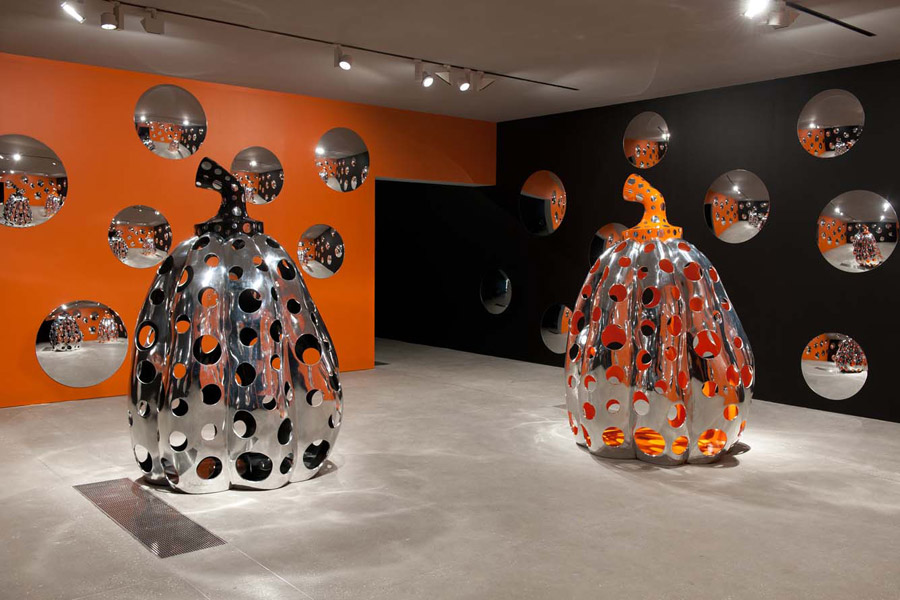
HAPPY HALLOWEEN! The pumpkins shown below are spectacular, unique versions by a fascinating artist, Yayoi Kusama.
Pumpkins are an important motif in Yayoi Kusama’s work, a fascination that extends from the artist’s youth during the years of World War Two. While Japan’s food supplies were generally disrupted, Kusama’s hometown of Matsumoto was relatively untouched by the conflict and local produce was in abundance. The family business was in wholesaling, and the Kusama storehouse was always full of pumpkins. Despite having consumed the vegetable to the point of nausea at the time, Kusama has maintained an attachment to its irregular, bulbous form.
Pumpkins first appeared in paintings and drawings executed during her studies of nihonga (traditional Japanese painting) at Kyoto Municipal School of Arts and Crafts. Their unpredictable, organic shapes are reminiscent of the automatic drawing technique of late Surrealism, the influence of which can be found in Kusama’s early work, and indeed across much Japanese avant-garde art of the early 1950s. Pumpkins would find renewed importance in Kusama’s practice as it expanded in scale in the 1980s and 1990s. Notable examples include her installation Mirror Room (Pumpkin) 1991, which simulated a vast field of the gourds, and was a component of her showing at the 1993 Venice Biennale; as well as giant outdoor sculptures, commissioned for Naoshima Island in Japan’s inland sea and for the Fukuoka Prefectural Museum of Art in 1994.
The significance of pumpkins to Kusama’s later work lies in the artist’s use of themes and motifs from her childhood. Formally, they are consistent with the blending of the manufactured and the organic in her sculptural work, while their random, almost mutant, appearance highlights the degree to which the natural world appears as strange and uncanny in modern culture. At the same time, they bear connotations of growth and fertility, and the sense that when a pumpkin swells to abnormal size it is a thing of wonder, a gift of the earth able to feed whole communities.
Her ‘Reach Up to the Universe, Dotted Pumpkin’ works appear as aluminium sculptures within a mirror installation, a technique Kusama pioneered in the early 1960s to solve the problem of how to visually represent the concepts of repetition, accumulation and infinity, concepts which are so important to her work. On one hand, Kusama’s mirror rooms open her self-contained, self-focused practice up to the world; on the other, they draw the world into the work. Here, this game of dualities is played out in a room with alternating black and orange walls, dotted with convex mirrors that replicate the gleaming, perforated exteriors and monochromatic interiors of the two over sized aluminium pumpkins.
Pumpkins first appeared in paintings and drawings executed during her studies of nihonga (traditional Japanese painting) at Kyoto Municipal School of Arts and Crafts. Their unpredictable, organic shapes are reminiscent of the automatic drawing technique of late Surrealism, the influence of which can be found in Kusama’s early work, and indeed across much Japanese avant-garde art of the early 1950s. Pumpkins would find renewed importance in Kusama’s practice as it expanded in scale in the 1980s and 1990s. Notable examples include her installation Mirror Room (Pumpkin) 1991, which simulated a vast field of the gourds, and was a component of her showing at the 1993 Venice Biennale; as well as giant outdoor sculptures, commissioned for Naoshima Island in Japan’s inland sea and for the Fukuoka Prefectural Museum of Art in 1994.
The significance of pumpkins to Kusama’s later work lies in the artist’s use of themes and motifs from her childhood. Formally, they are consistent with the blending of the manufactured and the organic in her sculptural work, while their random, almost mutant, appearance highlights the degree to which the natural world appears as strange and uncanny in modern culture. At the same time, they bear connotations of growth and fertility, and the sense that when a pumpkin swells to abnormal size it is a thing of wonder, a gift of the earth able to feed whole communities.
Her ‘Reach Up to the Universe, Dotted Pumpkin’ works appear as aluminium sculptures within a mirror installation, a technique Kusama pioneered in the early 1960s to solve the problem of how to visually represent the concepts of repetition, accumulation and infinity, concepts which are so important to her work. On one hand, Kusama’s mirror rooms open her self-contained, self-focused practice up to the world; on the other, they draw the world into the work. Here, this game of dualities is played out in a room with alternating black and orange walls, dotted with convex mirrors that replicate the gleaming, perforated exteriors and monochromatic interiors of the two over sized aluminium pumpkins.
Installation view of Reach Up to the Universe, Dotted Pumpkin 2011 as part of ‘Yayoi Kusama: Look Now, See Forever’, Gallery of Modern Art, 2011 / © Yayoi Kusama, Yayoi Kusama Studio Inc. / Photograph: Mark Sherwood
Subscribe to:
Comments (Atom)