Sunday, October 30, 2016

Blue Helps Expression

The blues in nature are so beautiful I have included a few to gaze upon below. Linda Lauren's post below examines some of the communication help blue promotes.  BBL


Blue is a perfect example of how color works, even when we do not realize it. And depending on the shade you use, the meaning can deepen. The primary use for blue is evident in social media. Blue is very helpful with communication, which may be why Facebook, LinkedIn and Twitter all sport a shade of blue. Even corporate or health facilities incorporate the color in their logos. It’s the perfect choice for the intention to connect with people. Some of the ways the color blue can help are as follows:
  • Calming, soothing and great for pajamas and bedroom color.
  • Freedom of expression may come easier.
  • Helps promote stress reduction and better sleep.
  • Useful to those in the writing profession.
  • Insight and inspiration.
So the next time you find yourself needing to talk, discuss, communicate or relax,
remember the color blue. Wear it or include it in some way in your day so you are
encouraging the positive ways blue can be of service to you.

Wednesday, September 28, 2016

Fiber Art by Rachel Wright

Swirling seas and skies

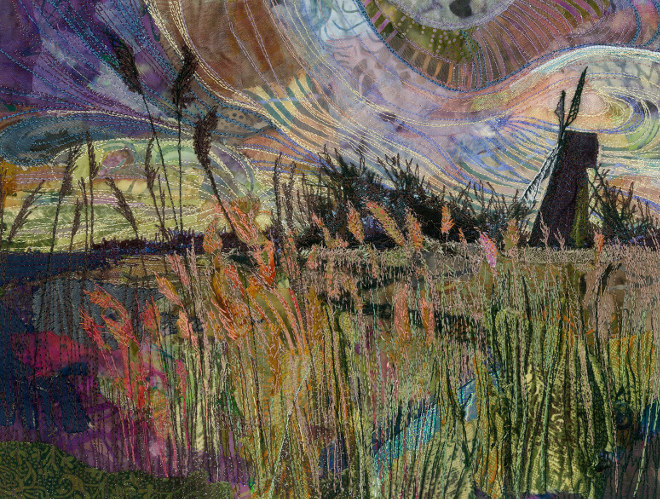
Reeds All About It by Rachel
Textile artist Rachel Wright from the UK recreates the world with a rich palette of threads, building up scenes that shine with beauty. She grew up surrounded by her father’s paintings, etchings and engravings. She felt that entering that world was a natural step, even if she did choose an entirely different medium as her paintbox.
“By the time I was in sixth form I was already looking for a university course in textile design,” she says.
Rachel was determined to bring her drawing skills together with her textile work, despite the fact that the college she attended really didn’t regard being able to draw an asset – “in fact, I’d go as far as to say they almost tried to beat it out of you!” (Unfortunately, this attitude about drawing prevails in many art schools-BBL)
Happily, since leaving college, she’s had the chance to explore the possibilities offered by melding her talent for portraying the natural world with her fabric prowess. “They lend themselves to the fluid restless motion that I try to portray in my skies and seas.”
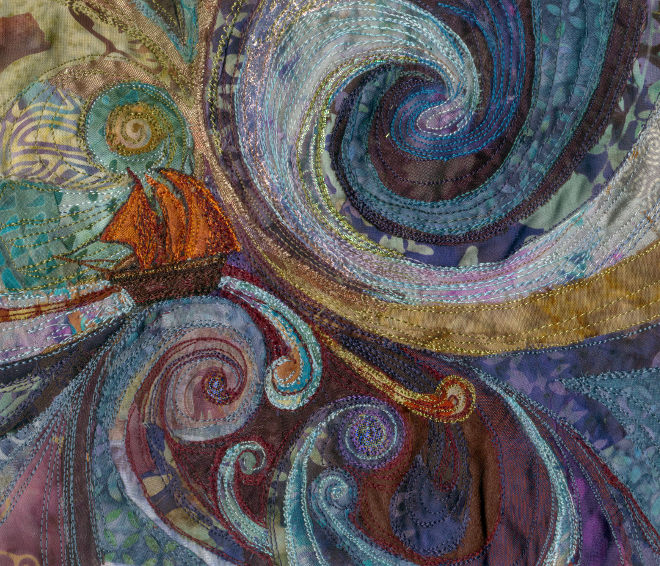
Any Port in a Storm by Rachel Wright
The vivid swirling shapes captured in her work conjure up a sense of energy and movement reminiscent of Van Gogh’s Starry Night. In Any Port in a Storm, above, there’s a palpable sense of peril and the drama of being at the mercy of a wild sea. To create a piece like this, Rachel selects the fabrics with care, and then machine sews them into the shapes that reflect the image in her mind.
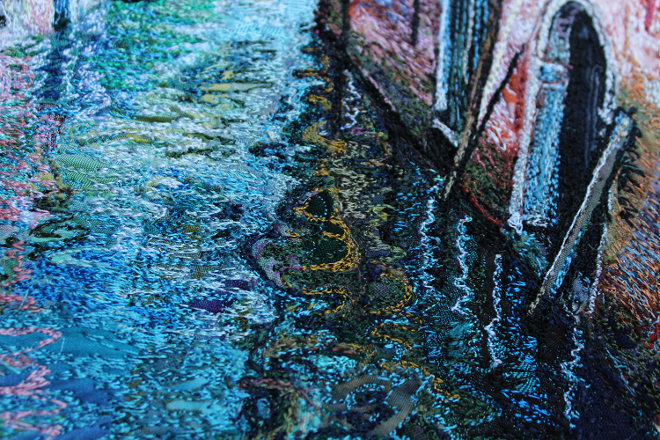
Floating City Detail 02 by Rachel Wright
“My first love was hand stitching but it was taking me far too long to complete each piece and once out in the real world I needed to start earning some money from my work,” she says. “My grandma had bought me my first sewing machine – it’s 30 years old now and still the one I still use everyday!”
Selling her work offers an emotional benefit too. “It’s such an enormous pleasure to know that people are prepared to part with their hard earned cash, to own something that I have made,” she says. “I love walking into and exhibition and seeing those little red dots on my work. It’s the best feeling!”
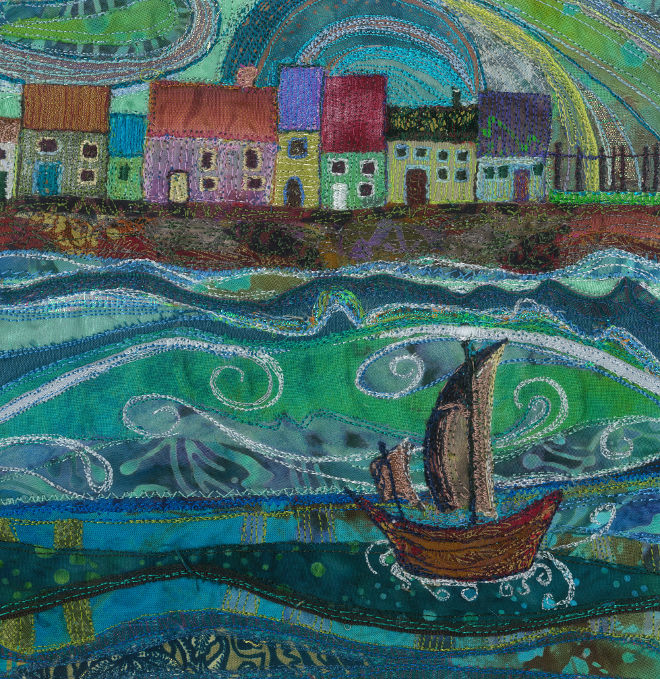
Hooray and Up She Rises by Rachel Wright
Her earliest pieces were beautifully abstract embroidery works, which provided her with the training to create the vivid landscapes and seascapes she’s now known for.
“I learnt a lot about using colour and composition, all of which stood me in good stead for the landscape pieces – using using fabrics, with all their wonderful colours, textures and patterns as my palette and threads as my paintbrush, adding in the details.”
Starting a brand new picture is the hardest thing, she admits. “I call it ‘Blank canvas syndrome’. Sometimes even the housework can suddenly seem like an attractive proposition when I should be starting a new piece. I really don’t like the beginning but inevitably, once I dive in and get going it’s usually only a matter of an hour or so before I’m hooked again.”
Almost Home by Rachel Wright
Rachel likes to work from photographs taken on walks or family holidays. “When I start to plan a piece, I will often sketch directly onto the calico before starting to work in the fabrics, “ she says. “I always like to have an image or several images to work from. I may not translate them literally but I think it’s important to know how something actually looks before you can start to play around with it.”
She adds: “My kids often get asked to draw things at school but are not given any reference to look at. It makes me mad because my dad always taught me to spend twice as long looking at the thing I was trying to draw, as I did actually making marks on the paper. Seeing what is really there is at least half the battle. It’s in noticing the small things that something becomes lifelike and realistic.”
That said, she has a passion for letting her creativity have free reign at times too. “I certainly like to allow my imagination in on the act. This is probably most evident in my foaming, swirling seas or my dynamic, dramatic skies.”
Find more of Rachel’s embroidered artwork at www.rachelwright.com.

Wednesday, September 21, 2016

Historical Color Palettes

Mankind has been making marks since pre-history. The palettes used through the ages show the progress we have made in capturing color for art.


Painting of a Bison (c.15,000 BCE)
Red and black polychrome image
from the Altamira Cave Complex
in Spain.

Prehistoric Colour Palette
Pigments Used by Stone Age Artists

The earliest art practised by humans - cultural cup-like hollows 
(petroglyphs) known as Cupule art, possibly dating as far back 
as 700,000 BCE - involved no color.

The earliest recorded appearance of color in prehistoric art is
 the assortment of red ochre lumps (dated to 70,000 BCE) 
found in the Blombos Cave on the coast of South Africa, 
about 180 miles east of Cape Town. This find included pieces
 of ochre which had been ground into primitive crayons. 
Unfortunately, archeologists found no actual artworks created
 with these crayons.

Artist Robert Burridge believes the first cave paintings were 
created  by women because of the smaller size of the 
prints made by the artists blowing "paint" around their
hands to serve as "signatures." 

Cave Painting in "Hall of the Bulls"
at the Lascaux caves in the Dordogne
dating from about 17,000 BCE.


Wednesday, September 7, 2016

How Does A Wine's Color Affect Us?

Wine aficionados say that drinking wine involves far more than a simple evaluation of taste. Aroma, temperature and a lovely bottle can all factor into our experience of, say, a Bordeaux. But, what if outside factors like a wine’s color, or even the lighting in the room we drink it in, can actually change how we perceive the flavor?
Wine colored rose


0:0
id Munksgard, a winemaker at Iron Horse Vineyards in Sonoma, California, says he uses a bit of red wine in some of his sparkling blends to hint at what the bubbly might taste like — before patrons ever take a sip.

“It sets the stage,” David Munksgard says. “If the wine was in a dark glass and you couldn't see, your brain wouldn't be working on that. You would just simply go on what it smells like and then what it tastes like. But you can't help it as a human being to start thinking about what that wine is going to smell and then taste like.”
Charles Spence agrees that color and other sensory phenomena can prime our brains for flavor, setting expectations about the taste that anchor our experiences when we’re actually eating and drinking. Spence leads the Crossmodal Research Laboratory at the University of Oxford and has studied the effects of “mood lighting” on our perception of a wine’s taste. He says that our tendency to color-categorize flavors may have evolved to help us judge our food for both ripeness and toxicity.
“What kind of world would we be in if we had to put everything to our lips to ... know whether it is nutritious or poisonous or not?” Spence asks. “So our brains learned to make predictions and say, ‘OK, I've learned that when I see a ripe red fruit color, it's probably going to be sweet. When I see something that's green, probably it’s unripe, maybe sour or less nutritious.’ If I can make those predictions, then I’m in a better place to know what trees to climb for the nutritious fruits and what else to eat.”
To test the influence of color on a wine's taste, Spence and his team ran an experiment in 2014 in which they gave over 3,000 Londoners red wine in black tasting glasses, obscuring the beverage's color. They then asked people to sip the same drink under white, red and green lights and rate how they thought it tasted each time.
“What we were able to show with these 3,000 regular drinkers — not wine experts or such — is that we get about a 15 to 20 percent change in people's perception of the fruitiness or freshness of the wine, how much they liked it, simply as a function of the background illumination in the room in which they were tasting,” Spence says.
For example, Spence says that even when we can’t see into our wine glasses, a red-lit room can nonetheless prepare our brains to expect sweetness.
“When we had winemakers who came to the Color Lab, this event, they were the real experts,” Spence says. “You’d think they would not be affected by the background color — [that] they can just identify what is in the glass, and the taste and bouquet. Yet, they were coming away saying, ‘Wow, we need to know about this.’”
Spence says that other sensory information can also help us make snap judgments about a wine's character well before we sip. Did you pop a cork, or crack a screw cap? What sound did the liquid make when you poured it into the glass? Sound, Spence says, is the “forgotten flavor sense.”
“From the sound of pouring ... you can tell something about the temperature,” Spence says. “You can tell something about perhaps the glass size. You can tell something about the kind of drink that’s been poured, and maybe even the viscosity. What information is there? We never really think about it, because normally we can see the wine, and yet our brain picks up on these cues and they too can subtly change our expectations.”
What about when you (or a waiter) set the wine bottle on the table, perhaps with a satisfying thud? Spence says that too is a game of the senses, to a point.
“When we've tested or evaluated the six or seven hundred bottles in the Oxford wine store ... what you find is that for every extra pound you pay, you get eight extra grams of glass,” Spence says. “There are some producers out there who are making bottles that are maybe a two and a quarter kilograms of glass when the wine is emptied, compared to others where it's less than a kilo [when] full of wine.”
Ultimately, though, you can’t put lipstick on a pig — or pass cheap wine off as finer stuff in a heavy, stoppered bottle.
“It may be that midprice wines can be shifted all over the place, but what do you call it? ‘Two Buck Chuck?’ (No longer $2-BBL)You might have a bigger challenge,” Spence says. “Just by putting it in a heavier bottle, you might convince some, but I think not all.”
This article is based on an interview that aired on PRI's Science Friday.

Wednesday, July 27, 2016

Cloud Colors

Why are clouds different colors?

Some clouds look white in color while others appear gray, black or other colors. How come?
The color of a cloud depends primarily on the thickness of the cloud says Brent McRoberts of Texas A&M University.

"As sunlight passes through a cloud, tiny water droplets that make up the cloud scatter all colors of the light in the same manner, producing a white color (the presence of all colors = white-BBL). As the cloud gets thicker, less light passes through to the base of the cloud and it appears darker (the absence of all color = black-BBL).
Where you are when looking at a cloud can also affect what color it will appear to you. If you are standing underneath the base of a tall cloud it appears gray because little light can penetrate the cloud. If you stand farther away from the same cloud and view it from the side, it will appear white because light is passing through the cloud before it reaches your eye."

To be continued....


Photo by author of the Fourth of July parade in Fredericksburg, Texas, 2016.


Wednesday, September 2, 2015

Van Gogh's only sale during his lifetime


The one painting Vincent van Gogh sold during his lifetime was Red Vineyard at Arles
(The Vigne Rouge), which is now in the Pushkin Museum of Fine Arts in Moscow.
It was exhibited in Brussels in 1890 at the annual exhibition of Les XX, and sold

for 400 
francs. 
It was bought by the Belgian artist and art collector Anna Boch. Vincent was  a friend  of her brother, Eugène Boch, A portrait Van Gogh painted of him is now in the Musée d'Orsay in Paris.

Anna Boch bought the beautiful landscape painting, dominated by red and yellow, with a composition that leads the 
eye into the distance towards the setting sun.
 In a letter to his brother Theo written in 
Arles around the 6th of November 1888, 
Vincent describes the scene he subsequently painted.in a letter to his dear brother.


"The Red Vineyard
We saw a red vineyard,
Completely red like wine.
In the distance, it became yellow
Against a green sky with a sun.
Fields violet and sparkling,
Yellow here and there after
The rain in which the setting
Sun was reflected."


After his death five months later, and that of his brother Theo soon thereafter, it was
Van Gogh's sister in law Johanna van Gogh who established a market for Vincent's paintings. She also delayed the publication of his letters so that
 
the public would get
to know the paintings before the man. "It would have been unfair to the dead artist to arouse interest in his person before the work, to which he had sacrificed his life, was recognized and appreciated as it deserved to be."

1. Simon Schama's Power of Art (page 298).
2. "The Posthumous Fate of Vincent van Gogh 1890--1970" in Studies in Post-Impressionism by John Rewald, Thames & Hudson, London, 1986. (page 244)
.

Wednesday, August 26, 2015

Marsala-The Color of the Year 2015 and a wine with a history


Shall we cook with Marsala, or drink it? Why not both? 
Marsala was named “Color of the Year” by Pantone in 2015. The burgundy-color intrigued me enough to lead me to investigate its history. The abbreviated version from About.com follows:

Marsala wine is Italy's most famous version of fortified wine, hailing from Italy’s sunny southern region, Marsala is an ancient city on the coast of Sicily. Like its other fortified cousins, Port, Sherry and Madeira, Marsala is a higher alcohol fortified wine (usually around 17- 20%) that is available in both sweet or dry variations. While Marsala wine is often recognized more for its use in various cooking and culinary combinations than its sipping status, this has not always been the case.
The History of Marsala Wine:
During the early 1800s, England had a significant military contingent established in Marsala in response to Napolean and the French occupation of Italy. Consequently, as the British discovered the regional wine and wanted to ship it back to the homeland they employed the same strategy that they discovered for making Port in Portugal. This strategy basically consisted of adding a little grape brandy to the local still wine and voila you have a fortified wine that can endure the arduous adventure of ocean shipping without becoming unpalatable gut-rot in the process.
And, if you curious about how Marsala Wine is made, read on:
Marsala is crafted from local, indigenous white grapes – like Catarratto, Grillo (the most sought after grape for Marsala production) or the highly aromatic Inzolia grape. The ruby-colored Marsalas hail from any combination of three local red grape varietals. The fermentation of Marsala is halted by the addition of a grape brandy when the residual sugar content reaches the pre-determined levels according to the sweet/dry style the maker is shooting for. Similar to the solera system of blending various vintages of Sherry, Marsala often goes through a perpetuum system, where a series of vintage blending takes place.
How Marsala Wine is Classified:
Marsala is generally classified according to its color, agealcohol content and sweetness/style.
Marsala Color Classifications:
·  Ambra (Amber colored) – made with white grapes.
·  Oro (Gold hues) – made with white grapes.
·  Rubino (Ruby colored) – made with red grapes, like Pignatello or Nerello Mascalese. (The Pantone color is based on this one! BBL)

·        Marsala Age Classifications
·        Marsala Fine – designates a Marsala wine that is aged for a minimum of one year. This is a typical cooking wine classification.
·        Marsala Superiore – refers to a Marsala wine that has spent up to three years in oak, but has a baseline minimum of two years in wood.
·        Marsala Superiore Riserva – has a minimum requirement of four years in oak and some producers will give it up to six years. This really starts the Marsala tier that you would look for to use as either an aperitif or dessert foritified wine option.
·        Marsala Vergine – has a minimum aging requirement of five years and may go up to seven years in oak.
·        Marsala Vergine Soleras – as the name implies is a Marsala blend of multiple vintages, with a minimum of five years of aging.
·        Marsala Stravecchio – aged a minimum of 10 years in oak.
·        Marsala Alcohol Content
The lowest aging classifications typically has the lowest alcohol content. For example, Marsala Fine is typically around 17% abv and the Superiore Riserva designation starts the alcohol content of 18%+ abv.
·        Marsala Sweet/Dry Style Designations: 
Like other wine sweet/dry designations, Marsala shares the terms: Dolce (sweet – typically denotes a residual sugar content of 100+ grams of sugar per liter), Semi Secco (semi-sweet/demi-sec – typically between 50-100 grams of sugar per liter) and Secco (dry – has a res. sugar content under the 40 grams per liter cut off). While Marsala is still known and loved as a cooking wine, in recent years the Italian wine designations have improved for this historic wine and as a result Marsala has been gaining quality ground and catching glimpses of its former glory in the form of both an acclaimed aperitif and dessert wine.
Marsala Food Pairings:
Smoked meats, walnuts, almonds, assorted olives and soft goat cheese are good options for a dry (secco) Marsala. Opt for chocolate-based desserts and Roquefort cheese for a sweeter Marsala wine pairing.

·        Marsala Producers to Try: (Recommended by wine experts)
Florio, Lombardo, Marco De Bartoli, and Pelligrino
My friends, I'm including a delicious recipe for
Chicken Marsala-Siciliano

Put thawed chicken breasts in a large ziploc bag and pound chicken into thinner portions with a mallet or rolling pin. Next, crush the croutons in another ziploc bag until they are fairly fine. Melt a half cup of butter in a saucepan with the crushed garlic clove. Then, dredge the chicken through the butter and place in the ziploc bag with the crushed croutons to thoroughly coat the chicken. Place the crouton crusted chicken into a shallow baking dish. Melt a little more butter and add a touch of olive oil to saute the mushrooms and add the sherry once the mushrooms get soft. Let it all simmer for another minute or so. Pour the sauteed mushroom mixture over the coated chicken breasts. Add salt and pepper and a dash of paprika if you like, and then bake for 40 minutes at 350 degrees. Top with fresh parsley.
Tip:
This dish is also EXCELLENT with chardonnay in place of Marsala or sherry if you prefer tangy over sweet sauce.